
Longevity Math: 3.4% Sounds Fine Until You Do It for 27 Years
5 min read
The July CPI report came out Wednesday, and the reaction was relief. Headline inflation cooled to 3.4%, the second straight monthly decline. Core came in at 2.5%. Prices rose just 0.1% for the month. Gas fell 2.9%. Every headline used some version of the word "cooling."
I've been sitting with that number for a few days, because it means something very different depending on how old you are. And because of where it leads: most of us are going to have to rethink what we call safe, before the math decides for us.
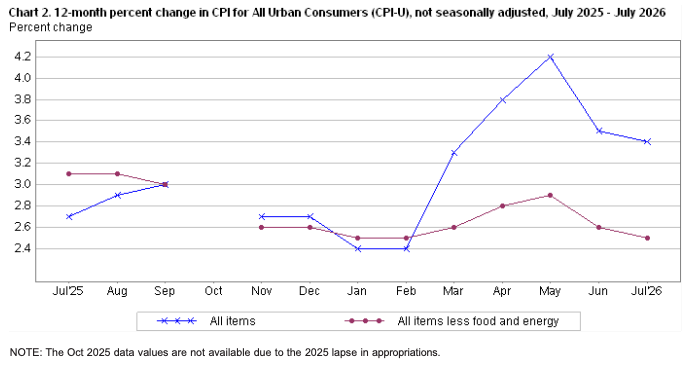
Source: U.S. Bureau of Labor Statistics.
If you're 40, that report is genuinely good news.
If you're 62, it's a warning most people are going to misread, because there are two numbers in it, and almost everyone is looking at the wrong one.
The Horizon Nobody Plans For
Start with how long this has to last.
For a couple both age 65 and in average health, the median survival period for at least one of them is 27 years. Not 20. Not the husband's individual median of 20 years, and not the wife's 23. Twenty-seven.
And the median is the middle, not the ceiling. That same couple has a 53% chance one of them lives past 90, and a 22% chance one reaches 95.
Most retirement plans stop at 85.
An actuarial write-up I read recently put the consequence more bluntly than I would have dared: a plan built to fund only to median life expectancy is, by construction, designed to run out of money for roughly half the people who use it.
Sit with that sentence. Not designed to be tight. Designed to fail, half the time, on purpose, by people who did the math correctly and asked the wrong question.
Apply 3.4% to That Horizon
Here's what 3.4% does over 27 years.
A dollar today buys about 41 cents.
Not in a crisis scenario. Not in a repeat of the 1970s. That's what happens if inflation stays exactly where it is right now, the "cooling" number, the one that got the relieved headlines, and simply doesn't move for the length of a normal retirement.
Run the same exercise at the Fed's 2% target and the dollar holds about 58 cents. That 17-cent gap between "target" and "cooling" is the difference between a plan that works and one that doesn't, and it compounds silently for a quarter century while nobody notices.
Rule of 72 makes it easier to hold in your head: at 3.4%, purchasing power halves in about 21 years. A 65-year-old couple's median horizon outruns that by six years.
The Second Number, and Why It's the Wrong One for You
Now the part most people miss.
Core CPI, the 2.5% figure, the one the Fed steers by, deliberately excludes food and energy. That exclusion makes sense for a central banker trying to see through volatility. It makes considerably less sense for someone living on a fixed income.
Look at what's inside the July report:
Energy: up 14.7% over the year. Gasoline up 24.6%. Fuel oil up 39.1%.
Shelter: up 3.2%, accounting for roughly two-thirds of the entire monthly increase.
Food: up 3.0%. Beef and veal up 9.4%. Fruits and vegetables up 5.1%.
Medical care: up 0.4% in July alone, one of the fastest movers in the month.
Housing, heat, food, and healthcare. That's not a random slice of the basket. For most retirees that's the whole basket, the four categories where spending is least discretionary and least postponable.
You cannot decide to consume less heat in January because the CPI print was encouraging. You cannot defer a cardiology appointment until the shelter index normalizes.
So the number that cooled is not the number you spend.
Core inflation is a policy tool. It was never a personal budget.
The Instinct That Makes This Worse
Here's where I part ways with a lot of conventional advice, and with what I suspect some of you are already planning.
The standard reflex as retirement approaches is to de-risk. Move to cash. Move to bonds. Protect what you've built. Capital preservation.
Over a 27-year horizon at 3.4% inflation, capital preservation is not protection. It's a slow, orderly, well-mannered loss.
Preserve $1,000,000 perfectly, zero volatility, zero drawdown, nothing lost, and in 27 years you're holding the buying power of roughly $410,000. You did everything you were told. You never had a bad year. And you lost 59% of what the money could actually do.
The risk that ends retirements isn't a bad quarter. It's a good plan pointed at the wrong duration.
What Preservation Is Actually For
I'm not arguing against safety. I'm arguing that safety has a location, and most people put it in the wrong place.
The genuine danger in early retirement isn't inflation, it's sequence-of-returns risk. Take a large market decline in the first few years while you're withdrawing, and you're selling assets into weakness to fund living expenses. Those shares never recover, because they're gone. The same average return with the losses arriving late instead of early produces a completely different outcome.
That risk is concentrated in roughly the five years on either side of your retirement date. That window is what capital preservation is for. A cash and short-duration reserve covering the first several years of spending means an early downturn doesn't force you to liquidate at the bottom.
Outside that window, for the twenty-plus years that follow, you're not managing a pile of money. You're funding a liability that grows at 3.4% a year and doesn't negotiate. That job requires assets that can grow faster than the basket you actually buy from.
The correct question isn't "how do I stop losing money."
It's "what does this money have to outrun, and for how long."
How We Answer That
At BMG, longevity isn't a marketing word. It's one of the three pillars the practice is built on, and here's what it means operationally.
We plan to the horizon you might actually have, not the one that makes the spreadsheet comfortable, we assume 95, not 85. We treat inflation as the primary adversary in retirement, not volatility. And we put the safety where it does work, in the sequence window, instead of spreading it thin across three decades where it slowly bleeds out.
I've written variations of this argument three times now, and I'm starting to think it's the only idea I have.
In March I argued that the assets everyone called safe, AAA tranches, crowded defensive staples AAA tranches, crowded defensive staples were carrying risk precisely because nobody was looking. In July I argued that the emergency fund most people consider untouchable is quietly losing purchasing power in an account paying 0.01%.
Same shape here. The familiar thing gets mistaken for the safe thing, and the mistake only becomes visible after it's expensive.
Wednesday's report was good news. It was not an all-clear, and it was not a personal one.
If your retirement plan runs to 85, or if "capital preservation" is doing more work in it than you can defend out loud, let's talk.
Inflation figures are from the U.S. Bureau of Labor Statistics Consumer Price Index release for July 2026, published August 12, 2026. Longevity figures reflect Social Security Administration period life table data and survival probability modeling; individual circumstances vary substantially with health, family history, and other factors. Purchasing power illustrations assume a constant inflation rate and are for illustration only — actual inflation will vary. The views expressed here represent the author's personal opinion and are not investment, tax, or retirement advice. Past performance does not guarantee future results. Please consult a qualified financial advisor before making decisions about your retirement plan.