Rare Minerals, Six Months Later: Right Thesis, Wrong Price.
6 min read
In January, I made a case for rare minerals ETFs as a structural diversifier. Six months and one hawkish Fed later, I owe you a scorecard, including the part that doesn't flatter me.
Yesterday the FOMC held at 3.50%–3.75% on a 9-3 vote. Three dissents pointing the same direction hasn't happened since 2016. The 30-year yield touched levels last seen in 2007. The Nasdaq 100 closed in correction territory. Roughly 76% of traders now expect a September hike, up from 59% a month ago.
$REMX closed at $64.59 yesterday, 42% off its 52-week high, and down 24.6% since that January post while the S&P gained 5.4%. Thirty points of underperformance in six months.
The Scoreboard
| Jan 30 | Jul 29 | Return | vs S&P | |
|---|---|---|---|---|
| REMX | $85.63 | $64.59 | −24.6% | −30.0 pts |
| SETM | $34.73 | $27.79 | −20.0% | −25.4 pts |
| BATT | $15.17 | $13.88 | −8.5% | −13.9 pts |
| S&P 500 | 6,939.03 | 7,316.15 | +5.4% | — |
Price returns, excluding distributions.
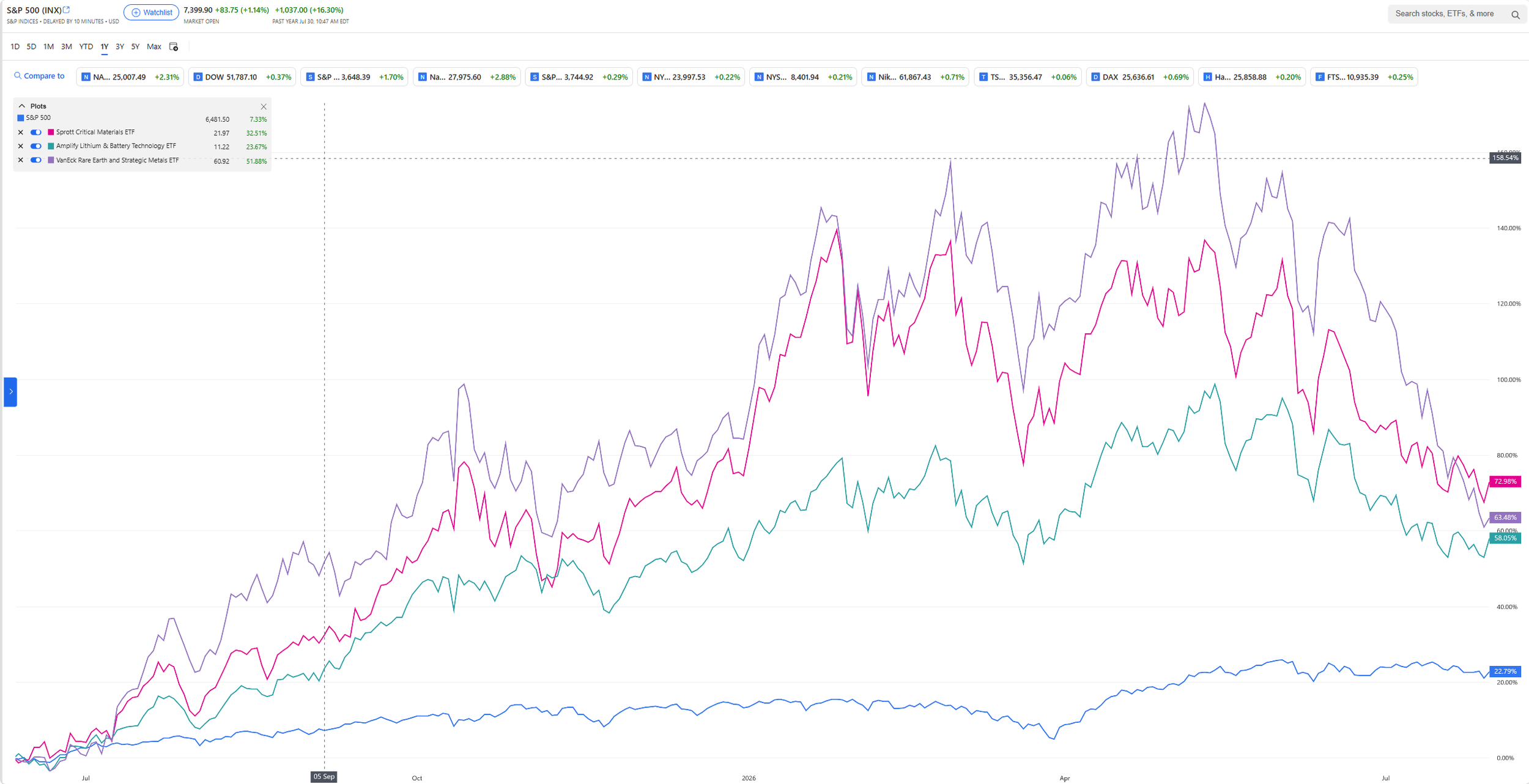
| Trailing 1 year | Return | vs S&P |
|---|---|---|
| SETM | +72.98% | +50.2 pts |
| REMX | +63.48% | +40.7 pts |
| BATT | +58.05% | +35.3 pts |
| S&P 500 | +22.79% | — |
As of the morning of July 30, 2026.
All three crushed the index. I could stop there, lead with the ugly number to look honest, then pivot to the flattering one and call it vindication. That's start-date shopping, and you should be suspicious of anyone who does it, including me.
What the two numbers together say is more useful: the sector had already run enormously before I wrote about it. By early September 2025 REMX was up more than 51%. By spring it had run past 158%. My January post, quoting 2025 returns of 87.86% and 87.39%, wasn't published at the start of this move. It was published deep inside it.
That's exactly when a structural argument is most seductive and least safe. The thesis was sound. The performance made it feel sound, which is a different thing and far more dangerous.
The twelve-month number says the thesis is real. The six-month number says I wrote about it at a bad price. Both are true. Only one is a lesson: a good idea bought at a bad entry produces a bad outcome, and being right about the idea doesn't fix it. That's an argument for sizing and staged entry, not for abandoning the idea.
A Correction I Owe You: These Are Not One Trade
$REMX lost 24.6%. $BATT lost 8.5%. Sixteen points of dispersion between two funds I presented in January as one idea.
They aren't. $REMX and $SETM are geopolitical supply-concentration trades, their driver is China. $BATT is an electrification demand trade, its driver is EV adoption and storage. They overlap at the edges and diverge everywhere else. Over twelve months $SETM now leads $REMX by nine points despite $REMX peaking far higher in the spring.
If you own all three thinking you own one position, you don't. Going forward I'll treat them separately, because they are.
Three Things We Didn't Know in January
1. China's leverage got more explicit, not less. China Northern Rare Earth set Q2 concentrate pricing at 38,804 yuan per tonne, a 45% quarterly jump, the seventh consecutive increase, more than double the year-ago level. Beijing also expanded export controls last October, then delayed implementation by a year. On July 16 the IEA warned that full implementation could put $6.5 trillion of downstream production outside China at risk. In January this was abstract. Now it has a calendar.
2. Beijing will target Western champions directly. In late June, China added USA Rare Earth and MP Materials to its restricted-access list; USAR fell 23% in June. Neither buys directly from China, the restrictions reach Chinese components inside their supply chains. That's more sophisticated than an export ban, and aimed precisely at what these ETFs hold.
3. The bottleneck isn't ore. It's chemistry. Chinese processing is now constrained by sulfuric acid shortages, worsened by Middle East disruption and China's own acid export restrictions since May. The world isn't short of rare earth resources. It's short of economical ways to process them outside China.
Why the Equities Fell: Two Reasons, and I Only Wrote About One
Commodity prices and mining equities are not the same trade. Higher Chinese prices help Western producers only if they can actually produce. June and July delivered the opposite: blacklisting, component restrictions, execution delays, dilution risk. The commodity got more valuable while the companies meant to capture that value got harder to operate.
The second driver I underweighted: rates.
Open the hood on $REMX or $SETM and most of what you own isn't a profitable miner. It's developers and explorers, no meaningful earnings, all value sitting in cash flows years away. That makes them long-duration assets in equity clothing. When the 30-year yield runs to 2007 levels, you discount those cash flows harder and the price falls for reasons that have nothing to do with China.
This isn't a footnote. The ex-China build-out is one of the most capital-intensive industrial projects the West has attempted in decades, mines, separation facilities, magnet plants, all of it financed. A Fed with three hawkish dissents is a Fed making that financing more expensive. Cost of capital is this thesis's single biggest vulnerability, and I should have named it in January.
The counterweight: inflation has run above target for five years while the Committee held five straight meetings. Persistent above-target inflation with a central bank unwilling or unable to break it is the textbook case for hard assets. So rates hurt the equities and help the underlying. Anyone telling you it's clean in either direction is selling something.
One more data point: $SETM took in roughly $80.7 million in net flows over the past month against $116.2 million over three. Money accelerated into the drawdown. That's not retail panic.
The Rules: Add, Hold, Trim
Written down, in advance, so you can hold me to them.
ADD when the catalyst confirms, not when it's announced. A binding Western off-take with a price floor, a funded DoD or DoE award that reaches construction, or commercial-scale separation running outside China. Not press releases. Not MOUs. And the bar just rose, "funded" now has to mean capital committed at a cost the project survives. Cheap money forgave a lot of optimistic mine economics. This tape won't.
HOLD when a correlated sector deteriorates. Softening EV demand, rolling PMIs, a materials selloff, that's cyclical weather against a structural position. Don't liquidate a ten-year thesis over a two-quarter air pocket. Don't add on the way down either; cheap is not a catalyst.
TRIM on parabolic moves, always. A satellite that doubles is no longer a satellite. That's arithmetic, not a market call, and it's the rule I'd most want back. When $REMX was up 158%, the right move wasn't a blog post explaining why it deserved it. It was trimming to target and saying so.
What Would Take BMG Fully Out
1. Durable Chinese liberalization. If Beijing permanently relaxes controls and prices normalize, we repeat the post-2010 cycle: supply fear drives Western investment, Chinese exports resume, prices fall, new projects can't compete. That dynamic killed the last rare earth trade. If it repeats, I'm out, not trimmed.
2. Western price floors fail or get repealed. The entire build-out depends on someone guaranteeing an economic price. Strip that and you're funding mines that can't survive contact with Chinese cost structures.
3. Substitution at scale. If magnet designs meaningfully thrift or eliminate heavy rare earths, demand assumptions break at the root.
4. Correlation converges. The original premise. I bought this for diversification, if these move in lockstep with equities across a full cycle, that benefit is gone and this is just a sector bet dressed as portfolio construction.
So let's check it. Over six months the S&P rose 5.4% and $REMX fell 24.6%. They did not move together. The criterion isn't triggered, and by my own rules I don't sell.
Remember, I wrote: lower correlation doesn't mean lower risk. That's the sentence that aged best, and not in a way I enjoyed. Uncorrelated doesn't mean "goes up when the market goes down." It means "moves on its own drivers." This year those drivers pointed down while the market went up, the promise working exactly as advertised, aimed where nobody wants it.
Note that three of those four criteria have nothing to do with price. A position that's down isn't wrong. A position whose reason for existing has expired is wrong. Those get confused constantly, usually at the worst possible moment.
Where That Leaves Us
The January case was that these return drivers are structural: geopolitics, industrial policy, supply concentration. It’s not sentiment. Six months made those drivers more visible, not less. What it also revealed is that this thesis needs cheap capital, and the Fed just made clear it isn't inclined to provide any. Q2 GDP and PCE land today. Jackson Hole is in four weeks. September is priced three-to-one for a hike.
All three funds are green as I write this, up two to four percent on a day the whole market bounced. Don't read anything into it. One green morning after a market-wide reversal is beta, not vindication.
The drawdown is real, it isn't over, and the macro isn't helping. But nothing here tells me the reason for owning this has expired, only that the reason for sizing it carefully was right all along.
Satellite. Not core. That was the call in January, and it's still the call.
If you're holding this and unsure whether your sizing still makes sense, or whether you own it for a reason you could defend out loud, let's talk.
Six-month figures are price returns from the January 30, 2026 close to the July 29, 2026 close, excluding distributions. Trailing twelve-month figures are as of the morning of July 30, 2026. Different measurement periods produce materially different results — that's the point of the comparison, not a defect in it. The views expressed here represent the author's personal opinion and are not investment advice. Past performance does not guarantee future results. Please consult a qualified financial advisor before making investment decisions.