
They're Not Fixing the System. They're Financing It.
8 min read
April is Financial Literacy Month. And if there's ever been a year where that framing felt insufficient, it's this one.
Not because the tools of financial literacy are wrong, they’re not. Budget. Save. Invest early. Let compounding do its work. It all holds.
But the conversation almost always stops before it gets to the harder questions:
What happens when the systems those tools depend on are operating in bad faith?
What happens when the environment itself is extracting from you faster than your discipline can accumulate?
That's the conversation we should have this month. And with some examples, hopefully recognize it immediately.
The Fundamental Contract of Business.
Every legitimate business starts from the same premise: there is a need in the market that isn't being met, and I am going to meet it in exchange for capital.
That's it. That's the deal.
The best businesses find an unmet need, solve it genuinely, and build a durable relationship with customers because the exchange of value is real on both sides. The customer gets something they needed. The business gets compensated fairly. The market (efficient or inefficient ) rewards quality.
But somewhere along the way, a different playbook emerged and it's become dominant enough that we've started mistaking it for normal.
The new playbook doesn't ask: how do I solve this better? It asks: how do I grow revenue regardless of whether the product improves?
Not by solving the problem more effectively. Not by deepening the quality of what they deliver. But by scaling volume, adding layers of extraction, and eventually (if they can get there) becoming so embedded in your daily behavior that you stop asking whether they deserve your money.
That's not a business. That's a toll booth that convinced you it built the road.
Let's Talk About DoorDash
DoorDash is one of the most instructive examples of this model operating at scale, and worth examining closely — not to dispute whether food delivery is useful, but to look at the structure underneath it.
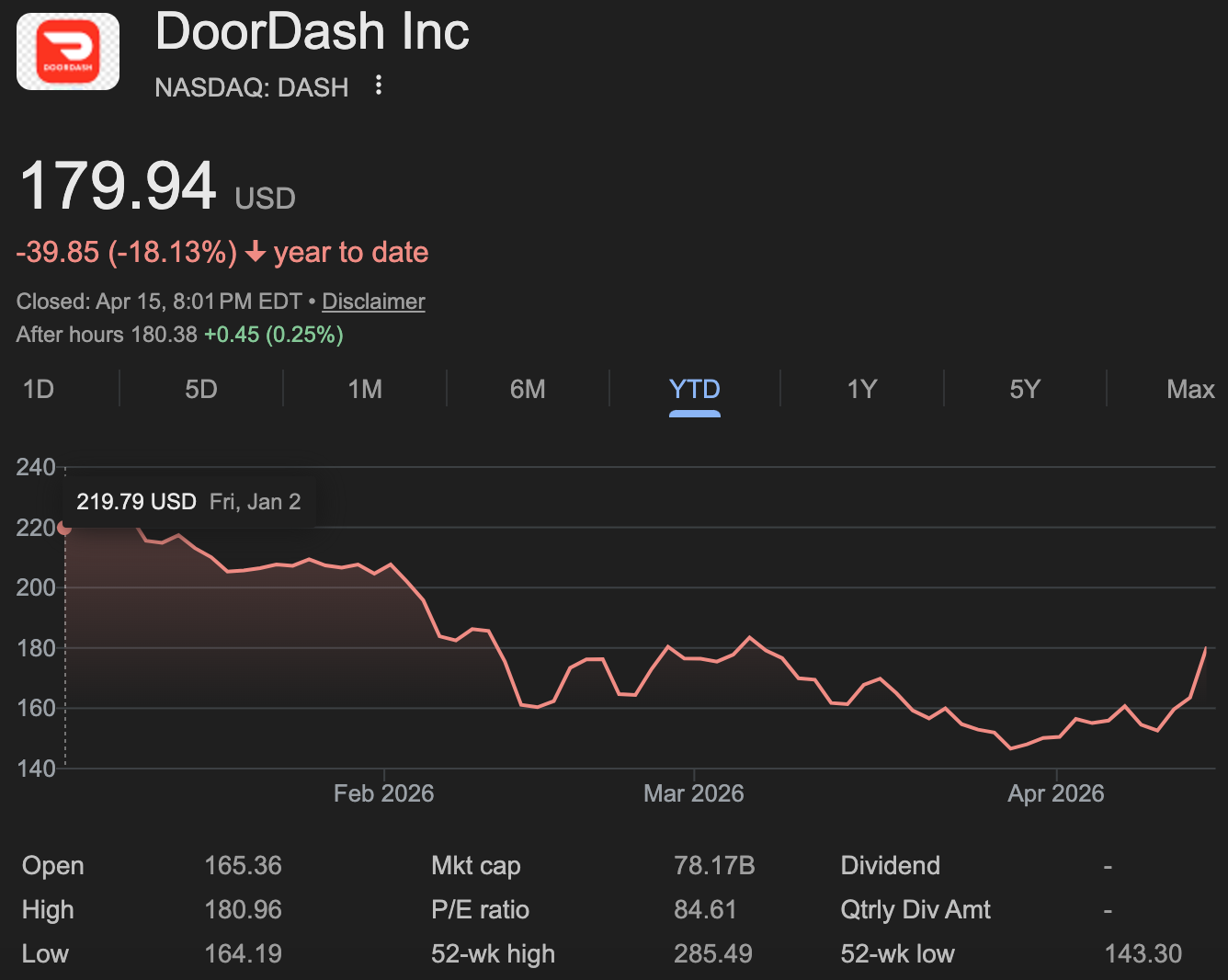
Although not at the first glance, DASH is up 7.7% today. Not because the food got better. Not because drivers are paid more. Just because a bank said robots might fix the math someday. A stock price tells you what the market is feeling but it does tell you whether a business deserves your loyalty or your money. Don't confuse the two.,
DoorDash makes more money the more drivers it onboards.
Not by paying those drivers better.
Not by improving the reliability of the platform.
Not by delivering a meaningfully better experience to the restaurants or the customers.
The revenue model rewards scale, not quality. The business grows by adding more supply to a system that still hasn't solved the fundamental unit economics problem at the center of it.
For years, DoorDash was growing revenue aggressively while losing money on nearly every transaction. The market rewarded the growth story. The underlying business was subsidizing your delivery fee with investor capital, training you to expect a price that was never real. That's not solving an unmet need — that's manufacturing a dependency on an artificially cheap service that the market couldn't actually sustain.
And then came the "pay as you go for food" concept — a financing layer designed to turn a $14 burrito into a revolving credit instrument. Whatever the stated rationale may be (that it might be more affordable than a credit card for some users) you have to step back and ask: why does a food delivery platform need to be in the lending business?
The answer isn't complicated. When you can't fix the core margin problem, you look for new ways to extract revenue from the same customer. You don't solve the original problem better. You build another layer on top of an unstable foundation and call it innovation.
This is going to unwind. Not because the concept of food delivery is flawed, but because a business model that grows by adding extraction mechanisms rather than improving core value has a structural ceiling, and the cracks are visible. I won't spend any more time on it here but the mechanisms (Automation) in my opinion of why it fails could fill a separate post.
The Same Pattern, At Every Scale
Now zoom out.
The same architecture that describes DoorDash also describes a lot of what's happening in systems that touch your financial life directly.
Financial products that make more money the more complex they are, not the better they perform. Insurance models built to collect premiums and construct maximum friction against claims. Healthcare billing designed to maximize extraction per encounter rather than outcomes per patient. Public programs that grow their administrative layer faster than their actual service delivery because the incentive structure rewards presence, not performance.
In my last post, I wrote about the quality trap — the idea that spending more doesn't guarantee getting more, and that a beautifully packaged product can still be a fundamentally inferior one. The quantity-over-quality failure mode isn't a corporate quirk. It's a systems design problem. And when it operates at the level of institutions that are supposed to form the foundation of your financial security — Social Security, Medicare, public pension systems — the consequences aren't abstract.
More money poured into these structures, without addressing the underlying design, doesn't fix them. It funds the dysfunction. It capitalizes the extraction. And it leaves you, the person who contributed faithfully for decades, holding a benefit that may look very different by the time you need it.
So What Do You Actually Do?
This is the part most financial literacy content skips. Let's not skip it.
1. Build on ground you control directly.
The single most durable financial move you can make in an uncertain environment is to maximize assets that sit in your name, under your control, with minimal intermediary extraction. That means prioritizing accounts where you understand exactly what's happening to your money. A Roth IRA funded with low-cost index funds isn't exciting. It also doesn't have a middleman taking 1.2% annually for the next thirty years. At a $500,000 balance, that 1.2% is $6,000 a year in fees — money that was supposed to compound for you, compounding for someone else instead.
2. Understand the difference between tax-deferred and tax-free.
Traditional 401(k) contributions lower your taxable income today. Roth contributions don't. The conventional advice has always been: defer now, pay later when you're in a lower bracket. But that advice was written in a different environment. If you believe — and there are reasonable arguments for this — that the fiscal pressure on the federal government over the next twenty years creates meaningful risk of higher tax rates, then "pay later" may mean "pay more." Diversifying between pre-tax and post-tax retirement accounts is a hedge against policy risk, not just market risk. Both deserve a place in your plan.
3. Keep your fee structure brutally lean.
Fees compound. This is not metaphorical — it is arithmetic. A 1% annual fee on an investment that averages 7% annual growth doesn't cost you 1% of your return. Over 30 years, it costs you roughly 25% of your ending balance. Every dollar you pay in unnecessary fees is a dollar that isn't compounding for you. Audit what you're paying. Vanguard, Fidelity, and Schwab all offer broad index funds with expense ratios under 0.10%. If you're paying significantly more than that, you need a compelling reason why — not a brochure, a reason.
4. Build a cash buffer that gives you decision-making room.
The reason people make bad financial decisions under pressure isn't usually a lack of knowledge. It's a lack of options. When your emergency fund is three months of expenses, a major car repair or a medical bill doesn't become a financial catastrophe — it becomes an inconvenience you absorb. Without that buffer, the same event becomes a high-interest debt spiral that takes two years to unwind. Three to six months of expenses, liquid, in a high-yield savings account. Not invested. Not locked up. Available. This is the foundation everything else sits on.
5. Be as skeptical of financial product complexity as you are of a food label you can't read.
This is the Moka pot principle applied directly. If you can't explain in plain language what a financial product does, how it makes money, and what happens to your money if the company offering it fails — you don't own it yet. That's not the rule of an unsophisticated investor. That's the rule of Warren Buffett. Complexity in financial products almost always conceals cost. The simpler your structure, the more of your return you keep.
6. Diversify across account types, not just asset classes.
You've been told to diversify your investments — across sectors, geographies, asset types. Good advice. But fewer people talk about diversifying across account structures — taxable brokerage accounts, Roth accounts, traditional pre-tax accounts, HSAs if you have access to them. Each of these has different tax treatment, different rules around access, and different exposure to future policy changes. Spreading across them isn't just tax optimization — it's optionality. It gives you flexibility to draw from the most advantageous source depending on what the rules look like when you actually need the money.
The Honest Summary
We don't know what the tax code looks like in 2040. We don't know what Social Security looks like. We don't know which businesses built on extraction economics are going to collapse under their own weight, and which ones are going to take consumer dollars down with them.
What we know is the same thing we knew about coffee: if the thing you're paying for isn't delivering real value, you have to either find the thing that does, or learn to produce it yourself.
That applies to your morning cup. It applies to your financial plan. And it applies to how you evaluate any system that asks for your money in exchange for a promise.
Meet that promise at the foundation. Ask what it's actually built on. And build your own financial life on something you can see, verify, and control.
That's what financial literacy looks like in the moment we're actually living in.
If this post made you think differently about where your money goes and why, the next step is a conversation. Book a free 20-minute call and let's look at what your foundation actually looks like.