
The Silence Dividend: Billions Lost in Tax Revenue to Protect the Myth of Political Power
3 min read
Behind every talking point about “mental health awareness” sits a quieter, more inconvenient story: a government willing to trade long-term economic capacity for short-term political optics. The most expensive line item in America’s mental-health crisis isn’t the cost of therapy or medication—it’s the silent drag on our tax base and productivity, as a shrinking, burned-out workforce quietly erodes the very system politicians claim to defend.
If you look at the economic mismatch in our mental-health system long enough, something uncomfortable becomes obvious: the U.S. government loses far more from a perpetually sick workforce than it gains from pharmaceutical-driven tax revenue.
And still—nothing changes.
Our system pours billions into pharmaceutical solutions that manage conditions indefinitely rather than attempt to cure them. That loop creates a predictable revenue stream for an industry with the strongest lobbies on Capitol Hill. But it also creates something else:
Millions of Americans who could be fully productive—reduced to partial or non-participation in the economy.
We don’t talk enough about the economic implications of that—because who’s buying ad space for that conversation? DraftKings? BetterHelp? MeUndies?
The Hidden Cost No One Wants to Model
Imagine two bars on a chart:
Bar 1: Federal tax revenue lost from citizens who, had they been healthy, could work full-time, earn higher lifetime wages, pay more income tax, spend more (sales tax), and contribute more to GDP.
Bar 2: Federal tax revenue (bill) generated by Pharma’s mental-health segment.
Every macro model and labor-market study points in the same direction:
The first bar dwarfs the second.
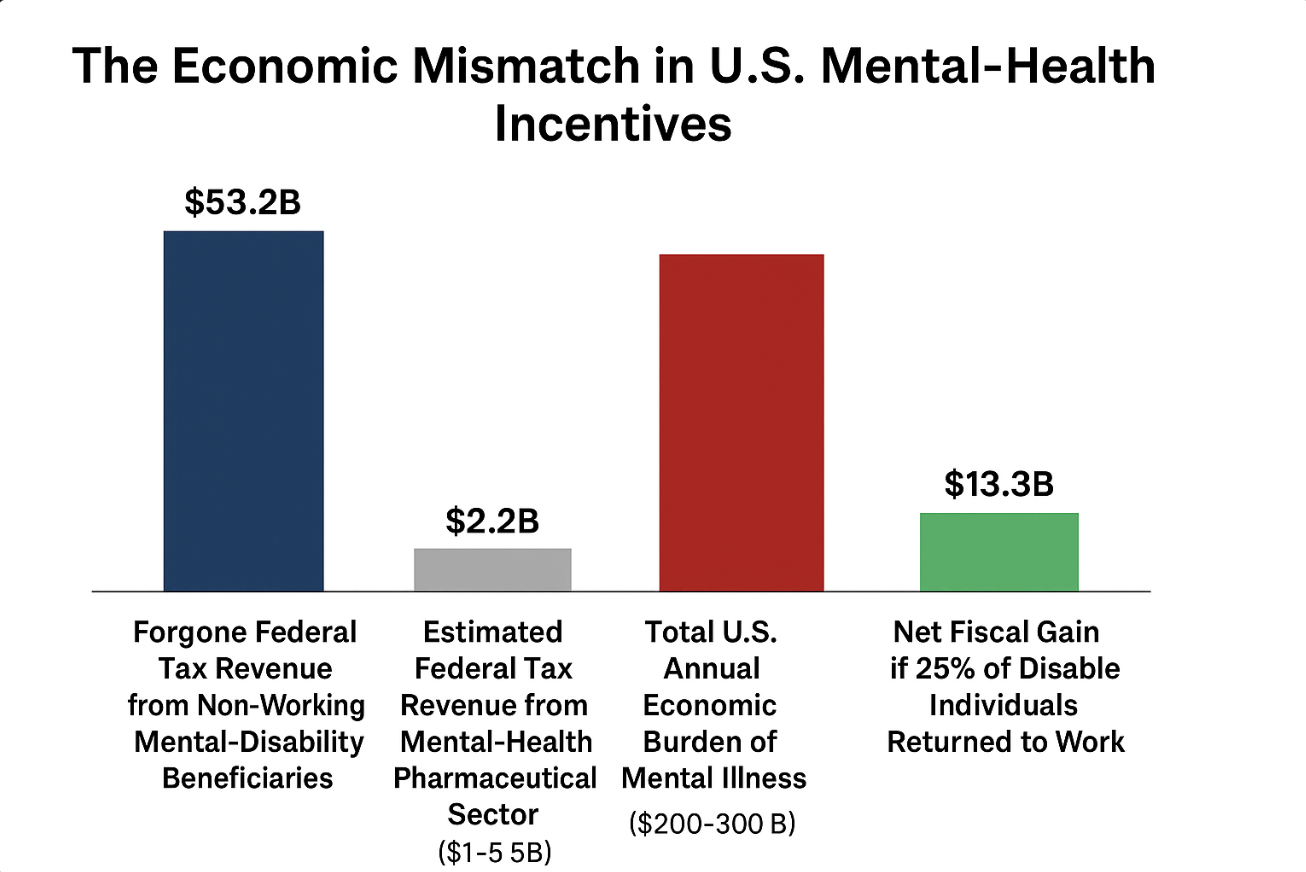
Yet government stays quiet. Why?
Because admitting that reality would require confronting a harder truth:
Washington’s incentive structure rewards maintaining the illusion of action, not the practice of results.
It rewards visibility, not value.
It rewards political “juice,” not economic stewardship.
Politicians keep the lights on by debating/campaigning fixes, showcasing short-term wins and not long-term structural gains. And so the biggest tax leak in modern American history continues—quietly, predictably, and with a smile.
The Silence Dividend
Call it what it is: a political economy where inaction pays better than reform.
Many observers have noted that politicians often avoid truly fixing problems so they can reuse them as permanent campaign issues.
A system where:
* voters see “programs,”
* pharma sees “customers,”
* politicians see “donors,”
and the economy sees… a shrinking labor force and lower lifetime earnings potential.
That gap—the difference between what the economy could generate and what we settle for—is the Silence Dividend.
Every worker pushed from full-time to the sidelines by untreated mental health issues represents tens or hundreds of thousands of dollars in lost lifetime tax contributions—that’s the Silence Dividend in practice.
A profit center for a few.
A tax drain for everyone else.
And that’s exactly why no one in power is rushing to break the loop.
So What Do We Do With This?
If we know the system isn’t built to maximize outcomes—only optics—then the takeaway is surprisingly practical:
We cannot rely on government to optimize anything for us.
We have to model our financial lives after the discipline we wish they had.
Not the gambler’s mindset.
Not the “one big score” mindset.
Not the Day trader fantasy.
But the opposite: Steady. Repeatable. Realistic. Risk-aware.
A strategy built for the long arc—not the political cycle.
Because the truth is harsh but empowering:
Governments can absorb losses for decades.
Households cannot.
You get one financial life—and no lobbyist is coming to save it.
Your job is to invest with the clarity, discipline, and long-term focus we wish Washington applied to our tax dollars.
The goal isn’t to swing for home runs.
The goal is to hit your number—your independence figure—without blowing up the account along the way.
CTA: Invest the Way You Wish Government Managed Your Money
At BMG, that’s how financial planning is built: disciplined allocation, low-beta strength, realistic compounding, and strategies built to survive uncertainty—not chase sugar-high returns
Because when you invest with intention, you’re not just avoiding the traps of the system—you’re outperforming the version of America we’re asked to tolerate.
If you’re ready to build a plan rooted in discipline—not delusion—let’s talk.