Black Ice II: Traction, Timing, and the Price of Being Too Safe
5 min read
New England winters can be brutal—and this one is shaping up just great🙄. There’s a specific point in my morning commute when I get the hunch that, before reaching my destination, I’ll hit black ice. Sometimes it catches me off guard; other times, I see it coming and adjust accordingly.
In 2025, investors who chose to drive carefully — playing defense, maintaining traction, and avoiding sudden moves — preserved capital and delivered respectable outcomes. Low-volatility strategies did exactly what they were designed to do. The iShares U.S. Insurance ETF ($IAK), long considered a defensive allocation, has eked out gains of just over 10% this year. That’s not a failure. It is outperforming the S&P 500 index on a risk-adjusted basis and in many market environments, that kind of return would be celebrated. But in 2025, it quietly introduced a different risk: the opportunity cost of being too cautious.
This post is a thematic continuation of last year’s blog entry. I wrote about black ice as a sudden shock — a moment when panic and overreaction briefly took control. What’s become clear since then, is that the ice wasn’t temporary. It became the environment.
Those who weren’t especially risk-averse are likely having a very strong year. Selective exposure to technology paid off, particularly for those who avoided chasing narratives and instead focused on balance sheets, cash flow, and pricing power. Rotating between sectors month to month or quarter to quarter mattered more than blind conviction. Flexibility became an edge and it rewarded investors who understood that risk hadn’t disappeared — it had simply migrated.
The most telling performance didn’t come from driving faster on the same icy road. It came from those who saw the conditions ahead and asked a more fundamental question: why am I even on this road?
In 2025, capital flowed decisively toward assets that sat outside the traditional risk spectrum. Gold surged more than 60%. Silver more than doubled. Uranium climbed over 50%. Commodities — long dismissed as dead money or tactical trades — became destinations. Not because investors suddenly fell in love with metals or materials, but because they quietly lost confidence in the systems meant to smooth volatility elsewhere.
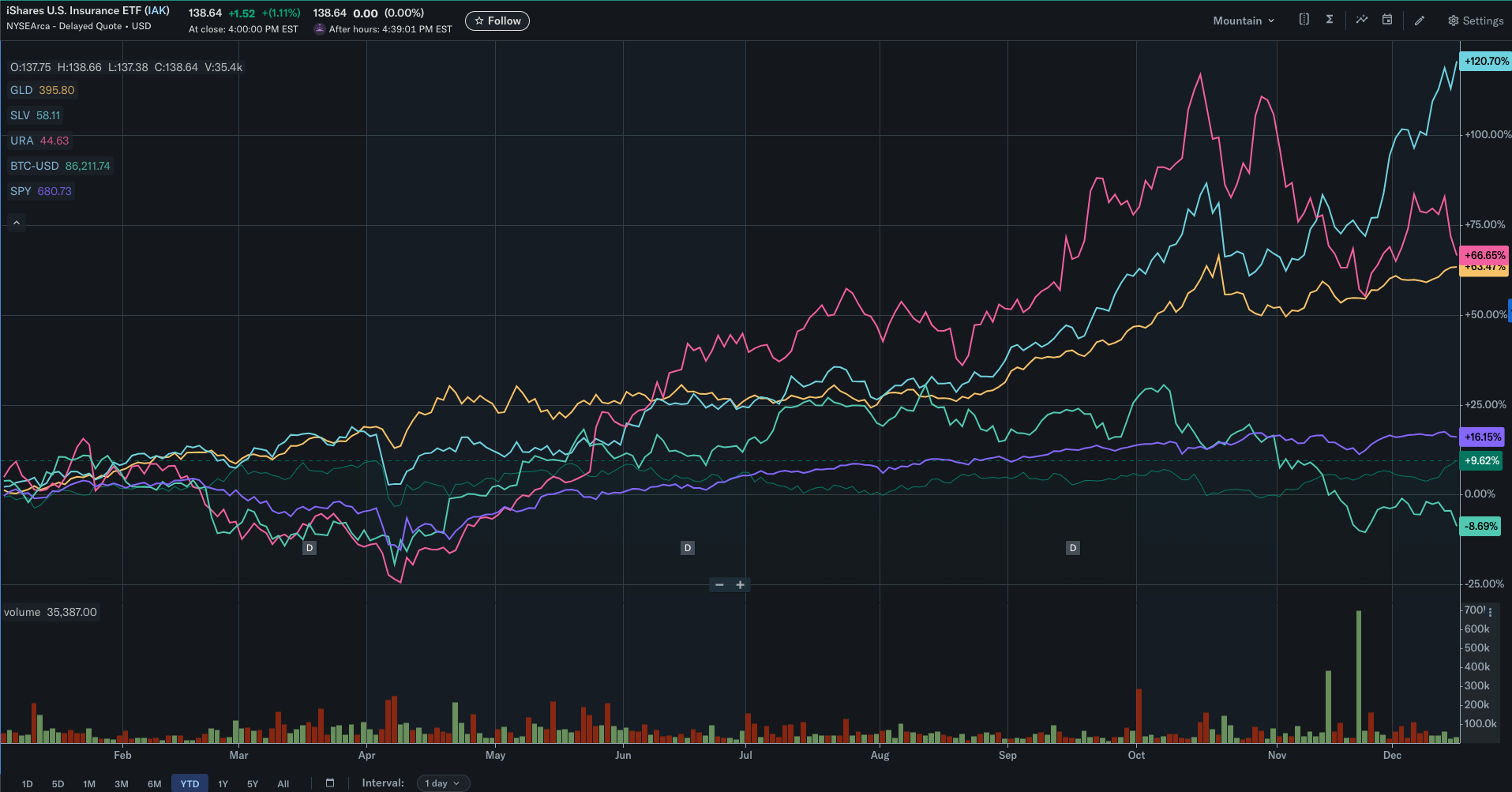
Year-to-date performance comparison of six major assets:
$SLV (silver ETF, teal) leads with +120.70%, followed by $URA (uranium ETF, pink) +66.65% and GLD (gold ETF, yellow) +63.47%. Traditional equity SPY (S&P 500, purple) returned +16.15%, IAK (U.S. Insurance ETF, green) +9.62%, while BTC-USD (lighter green) declined -8.88%.
When trust erodes, capital seeks tangibility.
It’s hard to ignore what that says about the broader environment. Equity markets continued to grind higher, with the S&P 500 up roughly 16% year-to-date, but the enthusiasm felt thinner, more conditional. Gains were earned, not assumed. Meanwhile, commodities acted less like speculative bets and more like parking lots — places to wait, to preserve purchasing power, to step out of traffic entirely.
This wasn’t about fear. It was about awareness.
In that same post, I wrote about “cognitive indifference” — the idea that as artificial intelligence and algorithmic decision-making take center stage, efficiency increasingly overrides empathy, nuance, and human judgment. In 2025, that concept feels less theoretical and more observable. AI didn’t just help make decisions this year; in many cases, it set the default. Underwriting, lending, healthcare access, hiring — the probability-driven framework expanded quietly, steadily, and with very little friction.
Markets reflected that shift. Risk was priced faster. Opportunities closed quicker. Alpha compressed in places where differentiation became automated. In that kind of environment, opting out can be just as strategic as leaning in.
Commodities, in many ways, were a referendum. Not on inflation alone, or geopolitics alone, but on system trust. They represented assets that didn’t rely on models behaving as expected, algorithms remaining stable, or institutions choosing discretion over efficiency. They simply existed — scarce, tangible, and outside the reach of probabilistic optimization.
None of this is to suggest that playing defense was wrong, or that caution was misplaced. Avoiding a crash still matters. But 2025 made one thing clear: safety is contextual. What protects capital in one environment can quietly cap it in another. Risk isn’t something to eliminate; it’s something to choose deliberately.
The investors who fared best this year weren’t necessarily the boldest or the smartest. They were the most intentional. They understood where they were being paid to take risk — and where they weren’t. They recognized when markets rewarded participation, and when they rewarded patience. And perhaps most importantly, they didn’t confuse activity with progress.
As we look ahead, the lesson from this past year isn’t about predicting the next trade or chasing what worked. It’s about adaptability. Static portfolios struggle in dynamic systems. Rigid frameworks break when conditions change. Planning, not prediction, becomes the advantage.
Black ice doesn’t announce itself. Sometimes the road looks clear until the moment traction disappears. In 2025, some investors tightened their grip and drove carefully. Others took calculated chances and accelerated at the right moments. And some simply exited the highway, parked their capital somewhere solid, and continue to wait for conditions to improve.
All three choices required intention.
Markets recover. They always do, in one form or another. But the way you navigate uncertainty — the risks you accept, the ones you avoid, and the systems you choose to trust — ultimately shape more than returns. They shape resilience. And in an environment where efficiency increasingly replaces judgment, resilience may be the most undervalued asset of all.
At BMG, that’s where we start. Not with forecasts, but with intent — and it’s a reason most of our clients stick with us. Because the goal isn’t to avoid risk entirely; it’s to understand which risks are actually worth taking, and which roads are better revisited later.